Wednesday, March 14, 2012

Schools are Full of Obsolete Things

"Schools are full of obsolete things: cassette players, Soviet-era political maps, curricula that treat technology as auxiliary to content, the idea that technology will save education (as opposed to the idea that relevance will)." -- Shelly Blake-Plock
from an article published today in EdTech K-12; check it out online and share!

Tuesday, March 13, 2012

Third Baltimore EdTech Forum

Digital Harbor High School is going to be electric with discussion and debate tomorrow eve as Baltimore City Public Schools CEO Andres Alonso and architect David Benn talk school architecture in the digital age.

So, if you find yourself in Charm City tomorrow night, you need to make your way down to Federal Hill to attend and take part in the Third Baltimore EdTech Forum!


Topic: THE FUTURE of SCHOOL ARCHITECTURE and LEARNING SPACES in the DIGITAL AGE

WHERE: Digital Harbor High School, 1100 Covington St., Baltimore, MD 21230

WHEN: March 14, 2011 // 6 to 8PM

FEE: Free and open to the public

The Baltimore EdTech Forum is an event designed to provoke visionary thinking and conversation about the future of education and technology in Baltimore. The event will feature presentations and discussion with Andres Alonso and David Benn and a large-format audience-driven group conversation about the future of learning spaces, digital age renovation, and building design in Baltimore schools.

http://www.edtechbaltimore.org/2012/baltimore-edtech-forum-march/

Thursday, March 08, 2012

Collaboration Grid

by John Spencer


In working with collaborative groups, I've noticed that tools are often chosen based upon comfort level, trendiness or simplicity rather than the function or the format in relationship to identity of the group and the purpose of the task. I've grown frustrated with brainstorms on visual topics where we used text-based tools or in trying to co-create something using a medium designed for communication. For that reason, I've created the collaboration grid. I realize that it's pretty arbitrary. I don't pretend to base this off of research or science. However, I thought I would share it with anyone interested.


THE FUNCTION

When I think about collaboration, I tend to think in two domains. I typically have times when I am co-creating and other times when I am communicating. On some level, the two will always co-exist in collaboration. However, sharing ideas over a cup of coffee is very different than painting a mural together.

In terms of online collaboration tools, I find myself using Twitter or Google Chat for sharing ideas and using Google Docs or Prezi for co-creating. For that reason, I have placed various web tools on a continuum between the creative and the communicative domains. Some tools fit evenly between these, like simple blogging, where the user is just as likely to engage and share as he or she is to create and post. Others fit on more extreme sides of each domain.

A few questions to consider:

  • Are we helping to ensure that we are creating rather than simply consuming information?
  • Is there a balance between sharing in the communication along with sharing in the creation of a product?
  • What is the nature of a tool with regards to creating and communicating?


THE FORMAT

In terms of format, there tends to be a continuum between text-based and multimedia. Some tools, like blogging and micro-blogging are toward the middle. However, Skyping with someone is a very multimedia experience while shared writing documents tend to be very text-based.

It's important that teachers and students think about the format as they collaborate. Too much reliant on text or visuals can skew the nature of the collaboration. A visual brainstorm on Pinterest will look far different than a text-based brainstorm on a Google Document.

A few questions to consider:

  • Does this allow for audio, visual or text-based information? If it allows for multiple representations, which one is it most geared toward?
  • How do these tools mirror in-person interactions? How do they vary from face-to-face interactions?
  • What is lost in this medium? (For example, tone of voice, facial expression, etc.)


John T. Spencer is a teacher in Phoenix, AZ who blogs at Education Rethink. He recently finished Pencil Me In, an allegory for educational technology and A Sustainable Starta book for new teachers. He also wrote the reform-minded memoirs Teaching Unmasked: A Humble Alternative to Waiting For a Superhero and Sages and LunaticsHe has written two young adult novels Drawn Into Danger and A Wall for ZombiesYou can connect with him on Twitter @johntspencer

Tuesday, March 06, 2012

Teachers Reflecting on Reverse Mentoring

by Andrew Coy
"Reverse mentoring is a concept borne of the information age... Reverse mentoring asks the younger, technologically savvier youngsters to tutor or support the older generation in learning how to leverage social media, blogs, email, cloud-based services, and other tools that we now have at our disposal." -- Meredith Ely
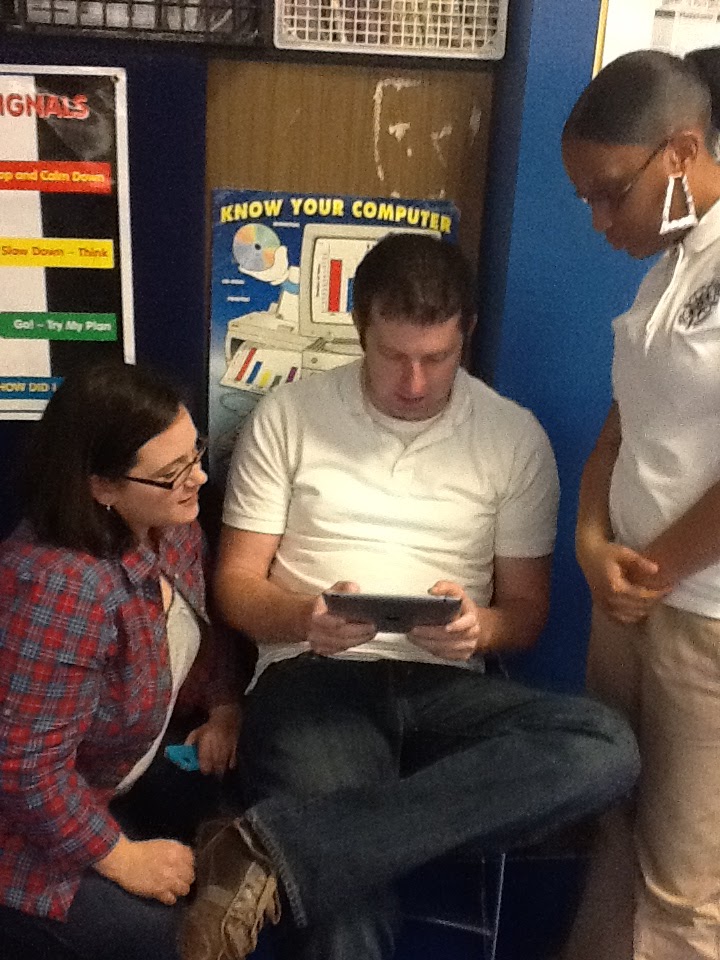
My students have working for a few months with teachers at Liberty Elementary as reverse mentors. This last week, we thought we would ask the teachers what they thought about it. I've included some of the responses below.

The Questions
  • What do you think about reverse mentoring?
  • How has your view of technology changed?
  • How do you plan on using what you do with us in the future?
  • What have you learned?
  • How have you applied what we have worked with you about?

The Responses


"I have absolutely loved the reverse mentoring program we've instituted here at Liberty Elementary.  I have learned so much from the Digital Harbor High School students- especially my personal instructor, Ykitta.  She's been patient and informative and has shown me ways to effectively use technology in a non-intrusive way. For example, I she helped me create a classroom web page that I can use to update parents and has also shown me how to seamlessly use multiple pieces of technology at once to enhance my instruction.  I look forward to our weekly sessions."
- Mrs. Adams


"I thought I was a technology expert - until I participated in reverse mentoring. Students now have such a greater breadth, and depth, of technological knowledge than I ever had growing up - even though they aren't much younger than me! I have learned so much more from the Digital Harbor High School students than I have ever learned from an adult through professional development. I am confident that, if we can instruct with the technological savvy our mentors have, our students will be equipped with the skills necessary to compete in a global economy. I look forward to the day when our student mentors become educators and have the opportunity to apply their technological awareness as a powerful instructional tool."
- Ms. Irmer


"It is making an impact on my instruction with my students and technology is making my lessons more interesting, fun and is student centered. The benefits of being mentored is the collaboration effort and we share ideas and how to incorporate technology in our class. I have learned a lot of good stuff especially on the different apps that my students use for center time or when they are finished with workshop and needs more activity to do, they get to use the iPad. Also, it has been helping me when I do guided reading or read aloud when we are working with a vocabulary word, we Google search the word and the picture/image appears." - Mr. Panaligan


Curious what your response to these same questions would be. Please leave us a comment and tell us if, how, and where you have seen reverse mentoring in your school. And if you haven't, why not? What are the obstacles to setting up a reverse mentoring program? And what role can and should reverse mentoring play in professional development for teachers?

(See LearnBoost's blog for the whole article by Meredith Ely and see City Biz List for a second article written by Newt Fowler.)


Friday, February 24, 2012

A Letter to the 14-Year Old Me

by John Spencer

Dear John,

So about school. I know you feel like a failure, but you're doing better than you think. You sometimes feel guilty about hating school while liking your teachers. Sometimes you even do the assignment just because you feel bad for teachers who internalize your apathy and think it's their fault. Don't beat yourself up over this. You think that FOIL is irrelevant to your life? You're right. You feel that the Periodic Table of Elements won't change how you live? Again, you're onto something. On most days you get frustrated and ask the question, "How will this help me live better?" Don't let school beat that question out of you.

Don't think that you suck at math simply because you don't memorize algorithms. Math is more than memorizing. Don't assume that science isn't your thing, just because you don't like to rip apart an animal in class. Some day when you have your own children you'll rekindle your love of science and realize it was never really all that dormant in the first place. Your penchant for staring at the sunsets or walking barefoot in the moonlight will never cease.

One of the greatest insights you have into life is that it's a vapor. I think you've always had it, but Lynn's suicide certainly drove that point home. I know you're squirming right now in the fact that I mention it. You want to brush it off with, "well she wasn't a close friend and really I'm okay." But I've seen you crying at night and I want you to know that there really was nothing you could do to save her.

You yearn for something real. The bad news is that you'll only get it in bits and pieces along the way, but when you do, you'll be amazed. You'll have some of the most life-changing teachers who speak truth into your soul in ways that others can't. You're deeply existential and sensitive and I know that feels like a curse right now, but it's a beautiful thing.

Beauty. You still cringe at that word. You still keep your poetry secret. That's fine, I guess. That solitude is how you will refine your craft. But there's nothing wrong with loving language. Being poetic isn't unmanly. Un-macho, perhaps, but not unmanly. Real men are warriors and poets who dream and act and listen. Embrace your desire to write. I know, I know, it feels like you're wasting your time reading books and writing stories, but these will serve you well in ways that you cannot predict.

With regards to being geeky, I can't help you. I know it seems like the girls aren't that into you and it's true. They prefer assholes at this age. For what it's worth, you've ignored some amazing geeky girls as well. Quit trying to learn how to throw a ball through the hoop. You and I both know they were lying to you when they said, "You can be anything you want to be." You're never going to be a star basketball player. But you know that sheer sense of joy you feel when you are almost floating on air in mile 7 of a long run? Someday you'll feel that on mile 19 as well.

The good news is that someday character will matter more than brawn and your acne will clear up and you'll find someone who is beautiful and intelligent and intriguing. You'll wake up next to her every morning and feel like the luckiest man in the world. And, yes, I know your junior high brain; you'll have plenty of sex and yes, it's all that it's made out to be. You won't call it sex, though. You'll call it making love and none of that will make since until you find that woman who will change your world.

In terms of your emotions, they never go away. You have moments when you lose your temper and you get frustrated with how easily you are hurt. You can't escape that. It is a part of who you are. Except, here's the neat part: they are redeemed somehow. I'd say God is a part of the process, but I remember what you were like in the eighth grade. That agnostic part of you laughs at the idea of God and for now that will do just fine. But someday that will be shaken. It's what happens when you ask too many questions.

Your anger will transform into this strong sense of social justice and you'll fight for what you believe in. Your sensitivity will move from something self-centered to others-centered and you'll find that your ability to listen and to empathize will make you a great dad and husband and teacher (permission to laugh at this - I know you can't believe you'll ever want to go back to school when it's over).

I know that life feels pretty awful. The cliques seem cruel. The kids seem fake. The subjects seem irrelevant. Trust me, even at thirty-one, I cannot look back on fourteen nostalgically. But I understand your hope that things will get better and I want you to know that your hope isn't wrong. Things get better. Way better. By the time you're my age, you'll spend most days feeling like the luckiest guy on the planet.

I won't end with a trite phrase like "be true to yourself" or whatever. I just want you to know that you'll be okay, John. You'll be okay. It really does get better.

Love,
John


John T. Spencer is a teacher in Phoenix, AZ who blogs at Education Rethink. He recently finished Pencil Me In, an allegory for educational technology and A Sustainable Starta book for new teachers. He also wrote the reform-minded memoirs Teaching Unmasked: A Humble Alternative to Waiting For a Superhero and Sages and LunaticsHe has written two young adult novels Drawn Into Danger and A Wall for ZombiesYou can connect with him on Twitter @johntspencer

Tuesday, February 21, 2012

The 3rd Baltimore EdTech Forum


Baltimore (and nearby) Folks:

WHAT: BALTIMORE EDTECH FORUM on THE FUTURE of SCHOOL ARCHITECTURE and LEARNING SPACES in the DIGITAL AGE
WHERE: Digital Harbor High School, 1100 Covington St., Baltimore, MD 21230
WHEN: March 14, 2012 // 6 to 8PM
FEE: Free and open to the public

Featuring a panel comprised of Baltimore City Public Schools CEO Andres Alonso, architect and principal of Cho Benn Holback and Associates -- David Benn, and artist and UMBC professor Callie Neylan, the evening will be dedicated to conversation and discussion about the Future of School Architecture and Learning Spaces in Baltimore's Digital Age.

On July 1, 2007, Andres Alonso became CEO of Baltimore City Public Schools. During his tenure, Baltimore City students have reached their highest outcomes in state exams, across all categories of students. City Schools saw its enrollment climb, following four decades of steady enrollment decline. It posted its best-ever dropout and graduation rates, driven largely by attention to all students, a focus on adult performance, the promotion of choice and school autonomy for all schools, and intensive efforts to engage parents and community.

The recipient of the Cornell University Eidlitz Traveling Fellowship Award, David Benn practiced architecture in London, Teheran and New York, and taught architectural design at Cornell University before joining Cho and Holback in Baltimore. He has won design awards from the Maryland Society and Baltimore Chapter of the American Institute of Architects, the Maryland Trust, the Waterfront Center, and the Maryland Chapter of the American Planning Association.

Callie Neylan is an interaction designer, researcher, and writer. She is an award-winning designer, with work recognized by Communication Arts, AIGA, and I.D. Magazine, and featured in the New York Times, Fast Company, and Gizmodo. Callie’s research interests include designing for the disabled, wearable computing, and the intersection of interaction design and the urban space. She is also exploring aesthetics in interaction design and is a contributing writer about design and technology for NPR.org.

The Baltimore EdTech Forum is an event designed to provoke visionary thinking and conversation about the future of education and technology in Baltimore. The event will be moderated by Andrew Coy, co-founder of the EdTech Forum and teacher at Digital Harbor High School.

Friday, February 17, 2012

Alma Mater

by Shelly Blake-Plock

Spending the morning at my high school alma mater today discussing pd and teaching styles. It's an interesting position to be in. Wondering what you all would say given the opportunity to talk with your alma mater about what effect they had on you (for better or worse) and where and how you would want to see them go into the new.

Monday, February 13, 2012

The Solution to Burnout Is a Better Story (Part Two)

by John T. Spencer

Last year, I allowed my story to slip into the Superman Narrative. My students were scoring well. The Clipboard Crew visited often. I wrote blog posts about what I was doing; beginning to believe I had more answers than questions. I tried to hide the imperfections. I yelled at kids a few times last year. I failed miserably at teaching science. I had to apologize at least once a day for something.

I took a job as a teacher-coach, believing that I had a duty to share my expertise. It was arrogant, I know. However, it was more about fear than anything else. I wasn't sure that I could repeat what happened last year. I had slipped into the wrong story.

Outward, I look "successful" in this current position. But inside, I'm dying to be teaching full-time. I left the classroom when I still loved being a teacher and now, as I teach during part of the day, I get a taste of what I missed everyday.

So, as I think about my return to the classroom full-time next year, I want to go back to the story that I had believed before:

  • Character: I want to be faithful, courageous and wise. But more than anything, I wanted to be someone who loves people well. If my students are engaged mentally and feel safe, I'm off to a great start.
  • Antagonist: The real antagonist was the system of standardization and the lie of perfectionism. Failure isn't the enemy. It's a chance to grow. Low test scores won't kill me. Really. 
  • Plot: It doesn't have to look exciting. My actions might look impressive (a mural or a documentary) but often humble (a debate, a project, an in-depth discussion) and that’s okay. It's not about the credit, the glory or the sense of superiority I feel when I am noticed. 
  • Setting: The real setting has to be my classroom. It isn’t about what the world sees or how I am noticed within the entire school. It's not about the Twitterverse or the Blogosphere or any other catchy name we have for the echo chamber of what's working. In my classroom, I'm broken and vulnerable . . . and yet, amazing things happen. 
  • Conflict: The true conflict is mostly internal: Will I be faithful? Will I remain true to my convictions? Will I be bold enough to fight against the standardized system? Will I get suckered into the wrong story?
  • Theme: It’s about providing authentic learning for all students. It's always been about thinking better about life. Period. If I can remember that theme, I'm better off for it.
*     *     *
John T. Spencer is a teacher in Phoenix, AZ who blogs at Education Rethink. He recently finished Pencil Me In, an allegory for educational technology and A Sustainable Starta book for new teachers. He also wrote the reform-minded memoirs Teaching Unmasked: A Humble Alternative to Waiting For a Superhero and Sages and LunaticsHe has written two young adult novels Drawn Into Danger and A Wall for ZombiesYou can connect with him on Twitter @johntspencer

Sometimes Slowing Down Leads to Burnout (Part One)

by John T. Spencer

I'm not saying we have to give 110%, but . . . 


I'm reading Trust Me right now and realizing, yet again, why John Updike was a brilliant author. I realize that he has grown less trendy in the last decade or so. Not postmodern enough. Too realistic. Too bold in crafting beautiful prose that is neither poetic nor particularly provocative. And yet every time I sit down  with his work, I am amazed by phrases like "the chemical scent of a pool always frightened him: blue-green dragon breath."

I have a hunch that Updike will be criticized for the sheer volume of his work. People like a tidy list of seven or eight really good works and let's be honest, Updike produced a few works that will be forgotten (and rightfully so). However, the only reason that he continued to write well was the simple fact that he kept writing.  He understood that the only way to refine his craft was to continue to push himself to produce more. Instead of worrying about running out of ideas, he recognized that one only grows stagnant by slowing down.

It seems counter-intuitive, but Updike's legacy suggests that burnout isn't caused by hard work as much as by a slowing down induced by fear and shame.  When I look at creative types who "burned out," I don't think it was laziness or lack of interest or the sense that they had nothing left in them. Instead, it was fear. I think Salinger, after writing Catcher in the Rye, realized that it was good, perhaps too good to be repeated and so he fled to mediocrity.

That was me last year. I worked really hard, had some great results and then fled into a teacher-coach role this year out of fear that I wouldn't be able to do it again. I ran away respectfully. I refused to admit just how scared I was that I would not repeat the kind of year I had last year. I allowed shame and fear to determine my self-concept as a teacher. And the hard part, the scary part of it, was that I loved teaching. I simply couldn't allow my success to depend upon standardized test scores. In other years, I almost hit the burnout point because of the dissonance between what I believed about education and what the system was asking me to do.

The issue was never hard work, but rather work that I was afraid I couldn't repeat combined with work that did not fit my identity. Hard work made me tired. Fear and shame led me to flee. I'm still teaching part-time, but I'm


Teaching is exhausting. I get that. A teacher spends hours in a passionate, emotional, sensitive state and on some level, that simply isn't natural. However, I have never seen a teacher burn out from hard work. Instead, a teacher is more likely to burn out by checking out, slowing down and giving themselves the permission to be less passionate and to care less in the name of balance. 


And that's me right now. I have more free time than ever before. I am not working anywhere near as hard as I did last year. I slowed down and now, as I teach only part of the day, I am dying to be back into the classroom full-time. I would rather be tired than spend my time doing something that doesn't fit who I am. I may not be able to repeat the success of last year, but I would rather fail trying than continue to slow down.

This isn't to suggest that balance is bad. Teachers need a personal life. There is nothing wrong with working fewer hours than in the past. However, when I watch teachers burn out, it is almost never because they were working too hard. In fact, the opposite is true. They often slow down as a result of burnout. Slowly, subtly, shame beats the passion out of them and they are left with a shell of a vocation. They don't burn out in explosion. They vaporize so slowly that you don't see it until it's too late.

*     *     *

John T. Spencer is a teacher in Phoenix, AZ who blogs at Education Rethink. He recently finished Pencil Me In, an allegory for educational technology and A Sustainable Starta book for new teachers. He also wrote the reform-minded memoirs Teaching Unmasked: A Humble Alternative to Waiting For a Superhero and Sages and LunaticsHe has written two young adult novels Drawn Into Danger and A Wall for ZombiesYou can connect with him on Twitter @johntspencer

Saturday, February 04, 2012

What We Can Learn from Great Car Salesmen

by Shelly Blake-Plock

My car was totaled in a wreck a few months back and I'm just now getting into the car-buying state-of-mind you have to be in to go to a dealership to find a replacement. Looked up the handful of models I'm interested in online -- the VW Jetta, a couple of Mazdas, the Ford Fusion, a Toyota or two, a Civic -- and did the "build your own" to figure out what I could get in the price range I had set for myself. Been to a few places on Sundays (when they were closed) just to look around the lots and see the cars in person.

Perhaps not surprisingly, the dealerships I've been considering are places that presented well online (the place just outside Baltimore that literally cut and pasted all of its inventory descriptions from a Canadian online magazine without so much as credit -- but whilst retaining phrases like "here in Canada..." -- well, they aren't getting my patronage).

Today was my first attempt to actually go in to a dealership to talk about getting a new car. It was a VW dealership on the west side of town where we were greeted by a man in a three-piece suit named Hans. A thirty-year veteran of auto-sales (most recently selling Porsches and picking up $6K a pop in commission until the economic downturn tasked him with selling Suburus and VWs, Hans had me hooked as much by his demeanor and great stories of racing 150mph on the Autobahn and his side project as a clock repairman as he did by anything he could tell me about the cars.

I knew all about the cars. I'd done my research online. I knew I liked VWs. I knew what a Jetta was going to cost me and I knew what that would run me per month. I knew all the available options and I knew what each trim offered. I knew how the car compared to others in its class and I knew what it's crash safety ratings were. Hans didn't have to tell me any of that. He just had to compel me to enjoy the car.

Not that I'd exactly equate car salesmen and teachers, but I think there is something for us to learn here. When we went for the second of two tests drives, Hans told me to accelerate hard at a certain point and, as I did, he explained the mechanics of the feeling I was getting from the accelerator pedal. As I blew passed a pickup on Route 40, he explained how best to sense all of those things -- torque, horsepower -- from the point of view of the driver's seat. Not once did he tell me the price of the car or ask me if I wanted to buy it. He just allowed me to experience it and helped me tie my experience into the engineering of the vehicle itself.

It was as much a master class in physics as it was a test drive.

As teachers, we're usually pretty good when it comes to content. And we're also pretty good when it comes to designing lessons. From a purely pedagogical standpoint, the most crucial part is linking those two things with the motivation and experience of the student. Because like any car buyer, they already have access of one sort or another to the facts. But the facts alone don't sell cars. And the facts alone don't sell education. It takes a guy like Hans who can give a master class in physics from the backseat of a speeding Volkswagon to make the sale.

Do you have a little Hans in you?

As postscript I should say that I didn't buy that car today. And I think I may have annoyed Hans a bit. But I did learn a lot and now I'm going to take that experience to the other shops I visit. And it just might turn out that I return to Route 40 and that I buy a car from Hans. We'll see.

From a teacher's perspective, however, I feel like I learned another lesson: sometimes it's not apparent that we've "made the sale". But we shouldn't assume. It's our part to impart knowledge and let that lead where it may. For all we know it will come back to us sooner or later. The challenge is to keep going out there for those test drives, riding in the backseat, and encouraging that kid with the hands on the wheel to really understand what they are doing.

- Posted using BlogPress from my iPad

Friday, February 03, 2012

Education Beyond School

By Shelly Blake-Plock

While there has been a lot of discussion recently in the news about making the school day longer, a group of us here in Baltimore are working instead to create a new kind of after school experience for city kids.

I'll be posting the specifics of what we're working on soon enough, but for today I'd just like to know about the kinds of after school activities your kids have benefitted the most from.

From sports to internships to outreach to chess club to team debate to drama club: what after school program have you seen make a difference in the lives of young people?

- Posted using BlogPress from my iPad

Sunday, January 29, 2012

What Would Happen If I Broke Up With Google?

by John T. Spencer

I'm bothered that Google has a profile on me. I've known it for years, but something about the new Terms and Services (I'd go Google it and add a link there, but I'm too lazy) seems like a creepier step closer to Big Brother.  Which I think is the problem. I already view Google as a Big Brother - a giant android there to help me, adding the training wheels to life and pushing me on my way so that I can function.

I make the assumption that my data is safe and that this profile is somehow different from the real me that taps away at a machine. But if the online me is still me, a part of me, full of interests and ideas and questions and drives - then I'm making a bold assumption about the inherent benevolence of Big Brother Google.

To illustrate the power of this codependent relationship, I'm thinking about what it would look like if I had a falling out with Google.  This has already happened in real-life with my twin brother and the lasting effects are that I'm a little more insecure relationally and I deeply miss the man who shares such a long history with me. On a relational level, the impact is subtly present. However, in terms of functioning, I'm doing okay at life without him.

Now, consider a falling out with Big Brother Google. In one day, I would lose all my contacts. I would lose my calendar, both in terms of what I have already done and in terms of what I need to do. I would have to ask sheepishly for people's birthdays. I would lose my ability to communicate with distant friends through e-mail. I would lose my blog, the domain name that goes with it and the community that has stuck with me for several years. I would lose whole manuscripts of books I wrote and books I'm trying to write. I would lose our family's budget and critical work documents and the fragments of spiritual journals that I started and then abandoned out of boredom. I would lose important things like the PD site I am developing right now and insignificant endeavors like the sketchy videos I've added to my blog.

In other words, I would lose a chunk of life. I would lose a sense of place. I'm sure I would find the manuscripts on my backup hard drive and I would find a way to go to Wordpress and I would hope that people still find me on Twitter. Still, I would instantly break relationships through lack of organization. I would feel lost.

There's something unnerving about how much I depend upon one corporation in order to function in this world. I still have a voice, but I'm willingly filtering it through the white noise of Google, hoping that when they claim "don't be evil" as a mantra, they'll stick to it.

Monday, January 23, 2012

The Most Important 21st Century Skill

John T. Spencer

Joel approaches me timidly. It's a rare weekend where I have no other choice than to work on school-related projects. He senses my frustration, so he whispers his request, "Dad, can we pick oranges and make orange juice?"

"Maybe later. I have to get this done," I respond.

He comes back five minutes later and I tell him, "Later means really later, okay?"

Christy calls him aside and says, "I'll help you. Daddy needs to work."

Something in the gentleness of her tone and the emphasis on the word "need" that pulls me from the office. I shut the laptop and put on my tennis shoes. It takes me a few minutes to adjust to the sun on my face and the cold air on my hands. But with every orange we snatch from the tree, I am forgetting about the website I need to develop or the videos I need to edit.

Brenna joins us. She picks thirteen oranges, but each time she counts, she stops at eleven. "I have eleven," she says to anyone willing to listen - to me, to Joel, to Micah, to the dog and to Micah's Papa Bear.

It feels like magic when the twirling machine converts each orange into juice. Joel is obsessed with technique and Micah is trying to figure out the mechanics, but Brenna is simply delighted to press down on each orange and watch the juice flow from the spout.

*     *     *

When I think about the skills I want my students to acquire, I often say things like, "think globally and act locally" or "recover a sense of the terrestrial reality around them."  Or sometimes I talk of sustainability and organic learning and growth and . . . what I really mean is I want them to learn what it means to shut off the devices, walk outside and pick oranges or plant a garden or study a sunset.

I want my students to figure out what matters in life and then have the courage, patience and endurance to live accordingly. The greatest twenty-first century skill is simply this: to learn to live well.

Mumford and Sons say it best:
Where you invest your love, you invest your life.


Sunday, January 22, 2012

Twimpact: Twitter's impact on my week

By Noah Geisel

I still hear people asking, often in a disgusted tone of voice, “Why would you use Twitter?” They say it’s just for people to see what celebrities are saying. They say it’s just a way for people attracted to the Me Generation ethos to transmit their self-centered Facebook musings to a wider audience. They say what they believe and I respect that, for them, it is the truth about Twitter. For me, Twitter is another story altogether.

The last 7 days have served as a shining example of how Twitter significantly impacts my teaching, learning and professional development. A sampling my week’s Twimpact:

  • I attended an inspiring TED Talks salon event that I found out about via Twitter. Had I managed to learn about it through other means, it would have been after the tickets were sold out.

  • I read dozens of articles and blog posts that were shared by the people I follow, 22 of which were helpful enough that I bookmarked them for future use. I copied the links and shared via email 3 of these articles with certain teachers and administrators in my building.

  • I read 12 tweets that I thought could be valuable to others and were worth Re-tweeting (sharing) to my followers.

  • I learned about 2 apps that I downloaded to my iPad and believe will be very helpful.

  • I learned a new trick for the Promethean Board that I never would have known was possible.

  • I reconnected with a teacher friend and brilliant education mind with whom I had not spoken in 18 months. It led to a phone call and awesome conversation that I already know will impact a lesson for my students later this week.

  • I had conversations with 16 other educators, many of whom I’ve never met in person.

  • I had two former students reach out to share with me what is going on in their lives.

  • I found out about a webcast hosted by an MTV VJ in Mexico, from which I discovered two new bands whose music I could share with my students.

  • I connected with the lead singer of one of said bands who has agreed to Skype with one of my classes about life in Lima, Peru.

  • I connected with a Venezulean baseball reporter who has also committed to a Skype conversation in which he will provide a season preview of the Colorado Rockies and take my students’ questions about the team in Spanish.

  • And, so as not to leave out the celebrities, I favorited 8 tweets by Spanish-speaking artists that used the same vocabulary that my students were studying so as to provide them with examples of Real World, in-context use of our target learning.


I get it that Twitter is not for everybody. In my teaching and learning however, it makes a huge difference. What is the #Twimpact for you?

Wednesday, January 18, 2012

Imagine if the Government Censored the Web

It would be like China or Iran or . . . the average American school.

Maybe it's time we advocate for open Internet in every context.

-John T. Spencer


John T. Spencer is a teacher in Phoenix, AZ who blogs at Education Rethink. He recently finished Pencil Me In, an allegory for educational technology and A Sustainable Starta book for new teachers. He also wrote the reform-minded memoirs Teaching Unmasked: A Humble Alternative to Waiting For a Superhero and Sages and LunaticsHe has written two young adult novels Drawn Into Danger and A Wall for ZombiesYou can connect with him on Twitter @johntspencer

Don't Censor the Web

Friday, January 06, 2012

Sometimes Lo-Fi Is The Answer


by John T. Spencer

It's a rough afternoon. My directions were too long and too specific and the students acted out in boredom. I took it personally and yelled. I'm trying to rethink my lesson for the following day with the knowledge that the Clipboard Crew will be stopping by in an effort to see the magical formula that leads to higher test scores. I should be honored, but I'm terrified. I'm doubtful. I'm doubtful about my inability to create the kind of story they're looking for.

I turn on the Iron and Wine cover of the "Waiting for Superman." The song is the perfect marriage of a broken, lo-fi*, acoustic sound with the themes of humility and expectations. I'm reminded that we're human. We're all broken (even the Clipboard Crew) and the amazing story is that powerful things happen in humble places.

It has me thinking about the notion of lo-fi and the concept that sometimes less is more:

Tools: My students blog and podcast and tweet and all that. And yet, give them a composition book and let them draw in it, sketch in it, duct tape it, organize it however they want and their Individual Learning Journals become a powerful statement about minimalism, humanity and the power of low-tech learning. If the Eco House project was a tech-infused Postal Service tune, their journals were Sufjan Stevens with a banjo singing Casimir Pulaski Day in a way that would make you weep.

Directions: The lo-fi approach reminds me that there is a power in simplicity. When I listen to Iron and Wine, I am reminded of the need to slow down and allow for additional mental space.  Fewer directions. Fewer assignments. It's often where students find the autonomy to personalize their learning. An indie classroom should have indie thinkers and indie thinkers should be able to customize their learning.

Discipline: One thing I love about the acoustic, minimalist sound is that it retains the human voice. I don't want a discipline management system. I want a relationship that respects the human voice.

Approach: I think it's interesting that Iron and Wine has brought back a pastoral, naturalist lyricism (that never really left). It has me thinking that the natural, the pastoral, the outdated might just be the vintage, the classic and the sustainable that we're missing in our standardized Pop 40 system.  It's not trendy by any means, but a philosophical discussion, a confusing parable or even a choral reading or a powerful story all have a place in the 21st Century Classroom.

*I know some people would have a fit with me calling Iron and Wine lo-fi. I get it. Lo-fi is often used in metal (especially 80's lo-fi) but I'm really intrigued by the acoustic lo-fi sound.

Tuesday, January 03, 2012

The Aaron Rodgers Story

By Noah Geisel

I’m watching an ESPN profile on Green Bay Packers quarterback Aaron Rodgers. If you’ve listened to five minutes of sports talk radio in the last month, then you know people are talking about his season as one of the best played by any quarterback, ever.

One thing that is striking about the story is how it relates to assessment. In the big money, high-stakes world of college football, a lot of work goes into evaluating young men and their potential. Expert scouting begins as early as 14-years-old. As a teacher, this sounds familiar.

At the beginning of the profile, the reporter talks about Rodgers’ dream of playing for Bobby Bowden at Florida State, and how the assessments of his abilities missed the mark: “Florida State did not want Rogers. Nor did any other Division I school.” A guy with a 1300 SAT who would go on to be a 1st Round Draft pick and NFL superstar launched his collegiate career at Butte Community College.

When asked why he believes he was overlooked, Rodgers responds, “Far too much weight is put into your height, your weight, your ‘40’, your bench press. The things you can’t measure: your character, your confidence, your mental toughness, your physical toughness, not as much weight is put into that.” Again, this sounds familiar to educators.

The Aaron Rodgers story is yet another reminder of why we educators need to be implementing in our classes (and pushing for system-wide) assessments that seek to measure the important skills that we know are essential for 21st Century success. We work in a world of high-stakes testing that primarily focuses on evaluating students based on multiple-choice, knowledge-based questions. Certainly, there is a place for assuring that our students have acquired the desired knowledge in our classes but with the weight that is placed on district benchmark exams, statewide assessments and even national exams, we need to be evangelists for the importance of measuring not only what students know but what they are able to do as well.

Tuesday, December 27, 2011

If School Is Not Relevant

by Shelly Blake-Plock

Had a conversation with a friend a while back; we were talking about how to best evaluate what was working in schools.

After rambling through all the usual arguments about testing and achievement and technology and pd, he said to me, "You know, for all the effort we put into the kids while they are our students, we do really little to gauge how we did once they are out the door. We treat school as though it is the most important thing in the world; and then they get out only to find that most of what they spent all those years doing there wasn't relevant. The only ones who ever really come back to talk to us are the ones who got something relevant out of school -- whether with grades or football or even the class clowns who owned the place while they were here. The kids who got something out of school come back and tell us how great we were. So there we are only getting feedback from the kids for whom the whole thing -- or at least something important in it -- worked. But when's the last time you heard back from any of those kids at the bottom of the rung? The quiet kids? The ones whose names you never could remember right?"

Most of the forms of evaluation and assessment we use have to do with finding out how a kid is doing right now; but "right now" isn't necessarily the best indicator of where we are headed. Even worse, "right now" often becomes a self-fulfilling prophecy. Think about how many kids in reality are graded and assessed in the minds of the teacher before they ever open their mouths; how they are assessed in advance based on the accumulation of all of those "right now" experiences and testing events devoid of the context of a child's life. Unfortunately, for a lot of kids, that becomes the de facto of their school experience.

That's not to knock teachers, it's just reality; as institutions, schools are really good at stereotyping kids and how that plays out at the classroom level in terms of attitudes accorded to students by faculty and peers alike -- well, that's an unfortunate but absolutely real part of the school(ed) experience.

And so we Scantron and five-paragraph essay our kids to death in the interest of getting them to achieve; but what is that elusive achievement? Is it a demonstrable improvement over time? (If so, why do we give grades based on summative assessments?) Is it an accumulation of honors? (If so, does that imply that most kids achieve nothing?) Is it an acceptance to the next level, the next school, the next diploma?

And what of when they leave our tutelage?

Imagine if schools were judged not by how well students achieved while they were in school, but in how well they achieved once they left. If schools saw their worth not in how many kids got accepted to college, but in how many kids went on to live meaningful and engaged lives and who would point back to their school years as the point of relevancy that was the foundation of it all.

If schools gauged themselves not by how many kids passed a test, but in how well it prepared those kids who did not pass the test to see themselves as worthy of respect and ready to take on the challenges of life. In fact, if schools worked to make entrepreneurs and role models of every kid who failed a standardized exam. If failure became a calling card for innovation.

If schools prided themselves on knowing the dreams of the quiet kids. If they prided themselves on helping those kids attain those dreams.

Dreams don't always fit into curricula.

Neither do successful failures.

We need schools that recognize failure as being as much a matter of how well one fits into a prescribed system than how well one understands, well, much of anything really.

And kids know we are blowing smoke when we give lip-service to how everyone should think outside-the-box and then we hand them a box and tell them that everything they've learned should fit back into it. And when they leave things outside-the-box we define them as failures.

We do this at our increased peril.

Because we are all failures of one sort or another. And though we like to focus on what we consider positive, it is more often the case that we live in a world comprised of systems of struggle and unanswerable questions. And we fail on a regular basis. And we need students who understand how to fail.

And we know this, yet we continue to punish students who fail -- as though our invented system of textbooks and number-two pencils were a better predictor of intellectual and creative capacity than life itself.

I wonder if I did a good enough job explaining that to my students. I wonder about the students who slipped through. I wonder about the ones who failed out.

I feel like they are the ones we should be talking to.

They are the ones who understand the impact of schooling. Enough of the smartest kids in the class always getting to answer the questions. I want to hear from the kids for whom school didn't work. I want to hear from the alumni who feel cheated by the system. I want our schools to be judged by how well we respected the humanity of the student who graduated with the lowest GPA and how we celebrated and engaged his or her capacity within society.

Because we are a society, we are connected one and all; and ultimately, if school is not relevant for that kid, school is not relevant for any kid.

Sunday, December 18, 2011

7 Things My Boss Gets Right

by John T. Spencer

Any leader who can get me to wear this is a great leader, indeed.

  1. Have Fun: I'm not referring to simply hosting a potluck. Some of the best leaders go over-the-top either with zany humor or with something extra-classy or with something deeply thoughtful. The bottom line is that these types of events tell a team that the leader is willing to go beyond the expectation. Tomorrow I will sport that outfit above for our department Ugly Sweater party. It is, admittedly, goofy. However, there is power in a shared, memorable, goofy event. 
  2. Be Supportive: I can't count the number of times that he has gone to bat for our department when we were being trampled on by the system or misunderstood by other leaders. 
  3. Be Critical: Chad is the type of leader who isn't afraid to engage in hard conversations when things aren't working. I can trust his words of affirmation, because he is honest enough to be critical at the necessary times.  
  4. Be Humble: I see this in small ways. For example, he sits with us rather than with the directors at meetings. He gives us credit anytime anything goes well and he takes the blame when things fail. He listens. He asks questions. When you work with a humble leader, you give them permission to enter into your world and the concept of submitting to authority doesn't feel like a chore.
  5. Be Innovative: Although creativity and innovation are edu-buzzwords, the reality is that the system often forces people to push compliance above change. I feel the freedom to push innovative ideas and the freedom to fail in the process. It's a powerful motivator. 
  6. Be Present: There is an intentionality to the moments when I am in his office. He is truly present. I've worked with people who are thinking about other things or trying to multi-task and the result is something even colder and less relational than an e-mail. 
  7. Trust: Although this is the last on the list, it's the most important. I trust my boss and because I trust him, I can be honest and vulnerable and he can step in and help when it's necessary. He doesn't micromanage. He doesn't nag. But he's not entirely "hands-off," either. Trust allows for freedom within the confines of safety.