Showing posts with label authentic learning. Show all posts
Sunday, September 18, 2011
What's different?
by Mike Kaechele
I thought I would reply to Shelly's question about what is different this year. I am at a new problem based learning high school that opened two weeks ago. We have just over one hundred freshman coming from twenty different districts in our county. They have never been in a PBL environment before so we spent the first seven days on a project where students explored what our school is about through various activities. On the last day they had two hours to edit videos they had been taking through out the week and present to their class. The groups are allowed to go into the common spaces and work collaboratively. This is what it looked like:
As a teacher I find this type of learning exciting. We have an open filtering policy. Between the open internet and structure some students are a bit lost and off task at times as this is such a huge culture shift from the traditional classroom that they are accustomed to. I will not claim that we have this all figured out but I loved this moment of walking around and watching students work. I am fully prepared to be amazed at what students will do the next few years as they grow in our space.
Here is one of my favorites:
I thought I would reply to Shelly's question about what is different this year. I am at a new problem based learning high school that opened two weeks ago. We have just over one hundred freshman coming from twenty different districts in our county. They have never been in a PBL environment before so we spent the first seven days on a project where students explored what our school is about through various activities. On the last day they had two hours to edit videos they had been taking through out the week and present to their class. The groups are allowed to go into the common spaces and work collaboratively. This is what it looked like:
As a teacher I find this type of learning exciting. We have an open filtering policy. Between the open internet and structure some students are a bit lost and off task at times as this is such a huge culture shift from the traditional classroom that they are accustomed to. I will not claim that we have this all figured out but I loved this moment of walking around and watching students work. I am fully prepared to be amazed at what students will do the next few years as they grow in our space.
Here is one of my favorites:
Wednesday, June 08, 2011
What I Learned...
By Shelly Blake-Plock
I asked my 9th graders if they felt like they'd learned anything this year. This response was the one that made me tear up:
"This way of learning made me learn it for myself my own way. It may have been difficult at first, but I have grown accustomed to it.... I have learned about myself and what I can do when I put my mind to it. Finally, I think that most importantly I learned that I can like to learn."
Talk to your kids. They've got a lot to teach you.
- Posted using BlogPress from my iPad
I asked my 9th graders if they felt like they'd learned anything this year. This response was the one that made me tear up:
"This way of learning made me learn it for myself my own way. It may have been difficult at first, but I have grown accustomed to it.... I have learned about myself and what I can do when I put my mind to it. Finally, I think that most importantly I learned that I can like to learn."
Talk to your kids. They've got a lot to teach you.
- Posted using BlogPress from my iPad
Friday, May 27, 2011
Learning About Culture Through Dance
by Shelly Blake-Plock
Thinking today about Sir Ken Robinson's thoughts about the travesty of dance not being taught in school. So, here's a short video of a small group of some of my 9th grade history students who are trying to understand the Renaissance... through dance:
Sunday, February 20, 2011
We need more "junk" in the classroom
by Mike Kaechele
We have mid-winter break this weekend so my family went over to Detroit and visited the Henry Ford Museum. Although I have lived in Michigan my whole life somehow I had never been there before. It is a huge place that emphasizes American advances in technology. Much of the technology is of the transportation variety with large exhibits of planes, trains, and automobiles but they also show changes in farm equipment, homes, furniture, culture, and huge steam engines. The subject matter is vast from science and technology to civil rights, American history, architecture, culture, and art. The technology really tells the story of the culture and history of America and the world.
My kids enjoyed looking at the thousands of items, but their favorite parts by far were the interactive parts. They ran to climb into any exhibit that they could.
They generated electricity.
They loved making these simple crayon rubs of exhibits.
They even enjoyed playing in an empty shack representing George Washington Carver's childhood home. We spent the longest time playing with K'Nex and drawing.
We built cars to go down bumpy ramps. After an hour we had to force the kids to go on to see the rest of the museum.
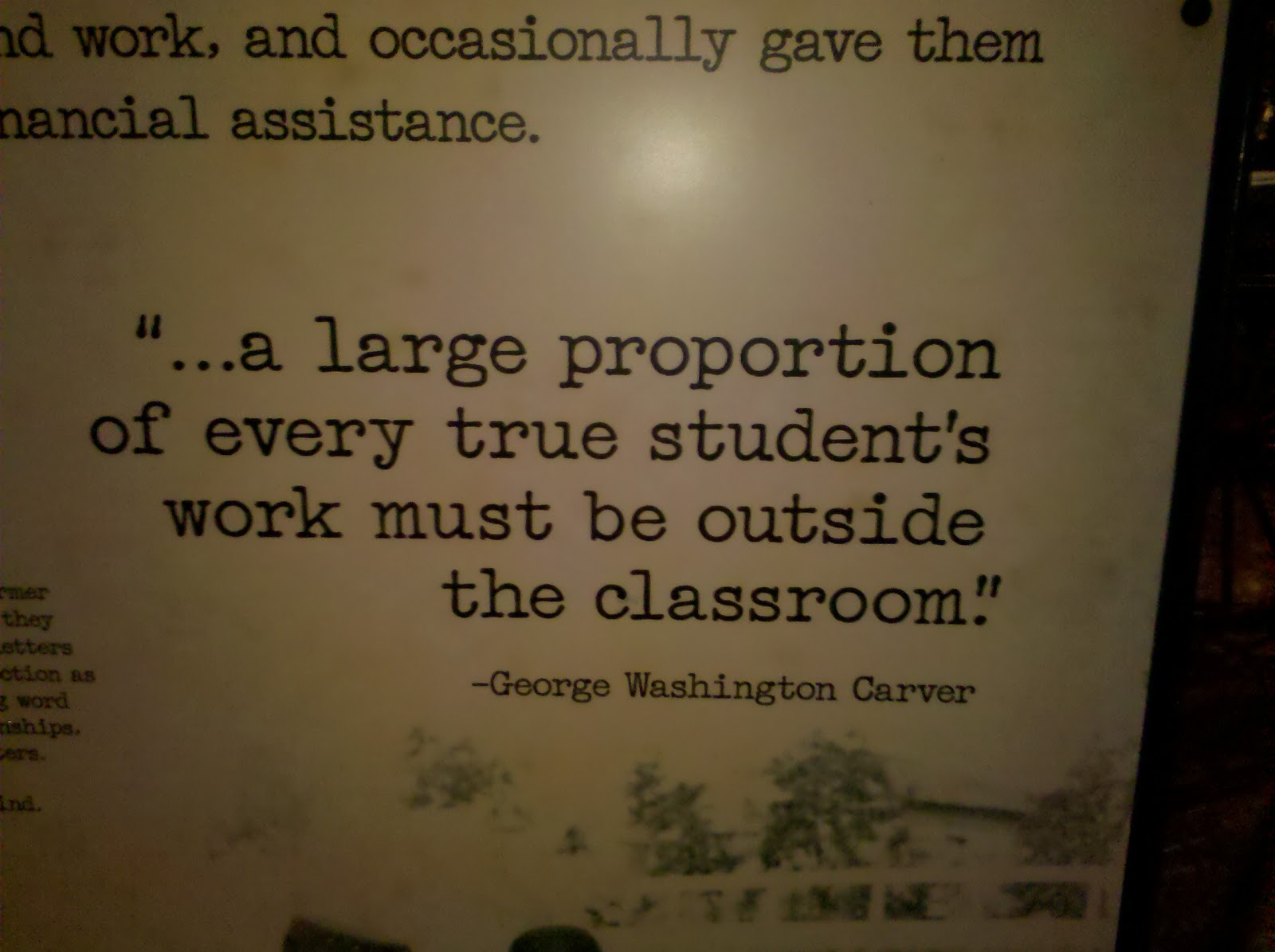
The temporary exhibit was on George Washington Carver. He was an amazing artist, philosopher, scientist, and educator. I was struck by how his holistic ideas of crop rotation and using natural remedies are just now being implemented and appreciated. He was a man before his time in so many aspects. His school was a working school that required students to be in the fields and woods exploring nature. They discovered by doing not by lectures in a classroom.
That is when it hit me. We don't need any new type of education. We need to use hands-on, problem-solving, student centered learning that has been around for over a hundred years. Museums are not divided by core subjects but are integrated by topics such as transportation or culture. Most of all, learning needs to be interactive. Reading good books counts as interactive too. Textbooks, not so much. The internet and online tools are just another development in hands-on learning.
Our classrooms should look more like museums with interesting things to touch, smell, taste, build, break, and play with. I think that is why students like science with aquariums filled with interesting creatures, birds nest, pine cones, etc. All classrooms should be filled with objects that cause students to ask what is this? What is it for? There is good pedagogy to be found in the design and items in a kindergarten classroom. That is why students love to use computers. They are hands-on too.
I have a few artifacts in my classroom that students are always interested in. I think I have a new goal to find some more. So what is the strangest thing that you have in your classroom to inspire curiosity?
We have mid-winter break this weekend so my family went over to Detroit and visited the Henry Ford Museum. Although I have lived in Michigan my whole life somehow I had never been there before. It is a huge place that emphasizes American advances in technology. Much of the technology is of the transportation variety with large exhibits of planes, trains, and automobiles but they also show changes in farm equipment, homes, furniture, culture, and huge steam engines. The subject matter is vast from science and technology to civil rights, American history, architecture, culture, and art. The technology really tells the story of the culture and history of America and the world.
My kids enjoyed looking at the thousands of items, but their favorite parts by far were the interactive parts. They ran to climb into any exhibit that they could.
![]() |
| Listening and sitting in same bus seat as Rosa Parks |
They generated electricity.
They loved making these simple crayon rubs of exhibits.
They even enjoyed playing in an empty shack representing George Washington Carver's childhood home. We spent the longest time playing with K'Nex and drawing.
We built cars to go down bumpy ramps. After an hour we had to force the kids to go on to see the rest of the museum.
The temporary exhibit was on George Washington Carver. He was an amazing artist, philosopher, scientist, and educator. I was struck by how his holistic ideas of crop rotation and using natural remedies are just now being implemented and appreciated. He was a man before his time in so many aspects. His school was a working school that required students to be in the fields and woods exploring nature. They discovered by doing not by lectures in a classroom.
That is when it hit me. We don't need any new type of education. We need to use hands-on, problem-solving, student centered learning that has been around for over a hundred years. Museums are not divided by core subjects but are integrated by topics such as transportation or culture. Most of all, learning needs to be interactive. Reading good books counts as interactive too. Textbooks, not so much. The internet and online tools are just another development in hands-on learning.Our classrooms should look more like museums with interesting things to touch, smell, taste, build, break, and play with. I think that is why students like science with aquariums filled with interesting creatures, birds nest, pine cones, etc. All classrooms should be filled with objects that cause students to ask what is this? What is it for? There is good pedagogy to be found in the design and items in a kindergarten classroom. That is why students love to use computers. They are hands-on too.
I have a few artifacts in my classroom that students are always interested in. I think I have a new goal to find some more. So what is the strangest thing that you have in your classroom to inspire curiosity?
Friday, June 19, 2009
Social Media's Possible Effects on Assessment, College Admissions, Identity, and Critical Thinking
Engaging discussion this afternoon at the Friday Chat. The topic of discussion concerned the ways in which social media will have an effect on assessment. Going back over the transcript of the chat, three things really struck out at me.
The first was how social media could effect college admissions -- and not in the sense of colleges looking for pictures from high school parties, but from the perspective of how a four-year social media portfolio might demonstrate more about the student's academic, intellectual, and creative capacities than a list of scores on exams ever could.
Second, we discussed the connections between authentic assessment and identity. I discussed this in a post yesterday and have had a lot of conversations about it today. I think it's one to give some real thought to, especially as we see the role of social media becoming more ubiquitous in all aspects of life.
Finally, we had an interesting talk about 'Critical Mass' as a teaching and assessment tool. I am fascinated by the possibilities of using Twitterfall and other forms of real-time search to facilitate critical thinking.
Here are clips from the chat:
On social media, assessment, and college admissions:
On the connections between authentic assessment and identity:
Using Twitterfall in assessments to teach critical thinking:
The first was how social media could effect college admissions -- and not in the sense of colleges looking for pictures from high school parties, but from the perspective of how a four-year social media portfolio might demonstrate more about the student's academic, intellectual, and creative capacities than a list of scores on exams ever could.
Second, we discussed the connections between authentic assessment and identity. I discussed this in a post yesterday and have had a lot of conversations about it today. I think it's one to give some real thought to, especially as we see the role of social media becoming more ubiquitous in all aspects of life.
Finally, we had an interesting talk about 'Critical Mass' as a teaching and assessment tool. I am fascinated by the possibilities of using Twitterfall and other forms of real-time search to facilitate critical thinking.
Here are clips from the chat:
On social media, assessment, and college admissions:
I agree w/ critical mass assessment. For a bottom-line oriented community, though, pointing toward a corpus of work might create conflicts. as in -- "this isn't quantifiable...how did you come up with these grades?" Sadly, more earnest assessment isn't always easy to explain. Nate at 3:25 PM, 19 Jun 2009 via web
I think that's changing. I think the final push will be when colleges completely stop accepting AP scores and move to student portfolios. Shelly at 3:26 PM, 19 Jun 2009 via web
As a result, I think teachers then create assessments that are retrograde b/c those structures are easy to perceive as being authoritative. Nate at 3:27 PM, 19 Jun 2009 via web
'Authority' is on the way out. Shelly at 3:27 PM, 19 Jun 2009 via web
I hope it's changing. Unfortunately, secondary schools w/ more clout w/ colleges are perhaps more able to take these kinds of risks. I'll have to ask some of my friends in college counseling how they perceive these types of portfolios. Nate at 3:27 PM, 19 Jun 2009 via web
The 'clout' issue... I think there may be a subtext there with regard to grade inflation. Shelly at 3:29 PM, 19 Jun 2009 via web
It'd be great if students could include on their college application a blog that they've curated for four years and shows intell. growth. Nate at 3:29 PM, 19 Jun 2009 via web
Admissions Counselors are savvy. They know what those scores mean. I think admissions wd prefer four-year portfolios. Shelly at 3:30 PM, 19 Jun 2009 via web
can you expand on what that subtext of grade inflation is? Nate at 3:30 PM, 19 Jun 2009 via web
And once they put the muscle of scholarship and financial aid money behind it: watch out! Goodnight AP exams. Shelly at 3:30 PM, 19 Jun 2009 via web
that'd be great. I think the CB tests do emphasize some important intell. skills, but the institution is just out to make $. Nate at 3:31 PM, 19 Jun 2009 via web
A friend told me a story that when he first came to this country from afar as a teacher, he was giving lot's of low-Bs as his highest grades Shelly at 3:32 PM, 19 Jun 2009 via web
Pandemonium ensued. Shelly at 3:32 PM, 19 Jun 2009 via web
That's the subtext of grade inflation. Shelly at 3:32 PM, 19 Jun 2009 via web
yeah, the issue of grade inflation is rampant at my school presently. Demographic fears (e.g. a top 10% policy) has created a ground-swell movement for higher grades across the board believing that will help. Nate at 3:33 PM, 19 Jun 2009 via web
Universities, more than ever before, are international. What do you think is going to happen to US students w/o changes in assessment? Shelly at 3:33 PM, 19 Jun 2009 via web
On the connections between authentic assessment and identity:
I also think that social media and blogging is a good way for students to really distinguish themselves and create a clear identity. Nate at 3:35 PM, 19 Jun 2009 via web
The 'identity of intellect'. Pappas wrote about this yesterday; I did a follow-up. Absolutely vital to student success. Shelly at 3:36 PM, 19 Jun 2009 via web
beyond assessment, I think social media helps clearly communicate that the teacher is also simultaneously learning from the students. Nate at 3:38 PM, 19 Jun 2009 via web
Students need to be connected to and validate one another; that's a successful society. Can't just be looking for approval from top. Shelly at 3:38 PM, 19 Jun 2009 via web
and that community-construction helps foster an 'identity of intellect' that you mentioned. Nate at 3:39 PM, 19 Jun 2009 via web
Recognition of teacher learning is a form of good modeling. In seeking information and analyzing info, we model intellect. Shelly at 3:39 PM, 19 Jun 2009 via web
Using Twitterfall in assessments to teach critical thinking:
how do you articulate the concept of "critical mass" to students? It seems a rather nebulous idea. Do you outline it on your syllabus? Nate at 3:42 PM, 19 Jun 2009 via web
We look at it in the 'real-world' and discuss what it means. Twitterfall is hands-down the best example for the kids. And the fun thing about Twitterfall is that it can be anything from the silliness of celebrity to the seriousness of warzone events. Shelly at 3:44 PM, 19 Jun 2009 via web
interesting idea about using Twitterfall to see meaningful vs. non- or less-meaningful postings, thoughts, etc. Nate at 3:44 PM, 19 Jun 2009 via web
Exactly. All a matter of being able to evaluate good writing and validate or invalidate sources. Shelly at 3:45 PM, 19 Jun 2009 via web
that's also a great idea for teaching students to read for POV/perspective; how to understand bias and pay attention to the source's origin. Nate at 3:46 PM, 19 Jun 2009 via web
Heck, I can tell you this: teaching bias via Twitterfall makes teaching Caesar and Augustus a piece-of-cake. Shelly at 3:47 PM, 19 Jun 2009 via web
yes, primary sources are opaque for students w/out contrasting it with contemporary primary sources--the bias, context, etc. students know. Nate at 3:49 PM, 19 Jun 2009 via web
Tuesday, March 03, 2009
Authentic Learning
A high-school Freshman writes:
Communication. Responsiveness. Vision. Creating the future. Filling the needs of the present. Community. This is authentic learning in the 21st century.
I'm a little excited, because today I just requested from the Pixton guy that he make a marble column, because it would help our class with Latin, and he did it. He sent me a confirmation and there is now a column object that we can use! That will help make it look more like Rome!
Communication. Responsiveness. Vision. Creating the future. Filling the needs of the present. Community. This is authentic learning in the 21st century.
Subscribe to:
Posts (Atom)